
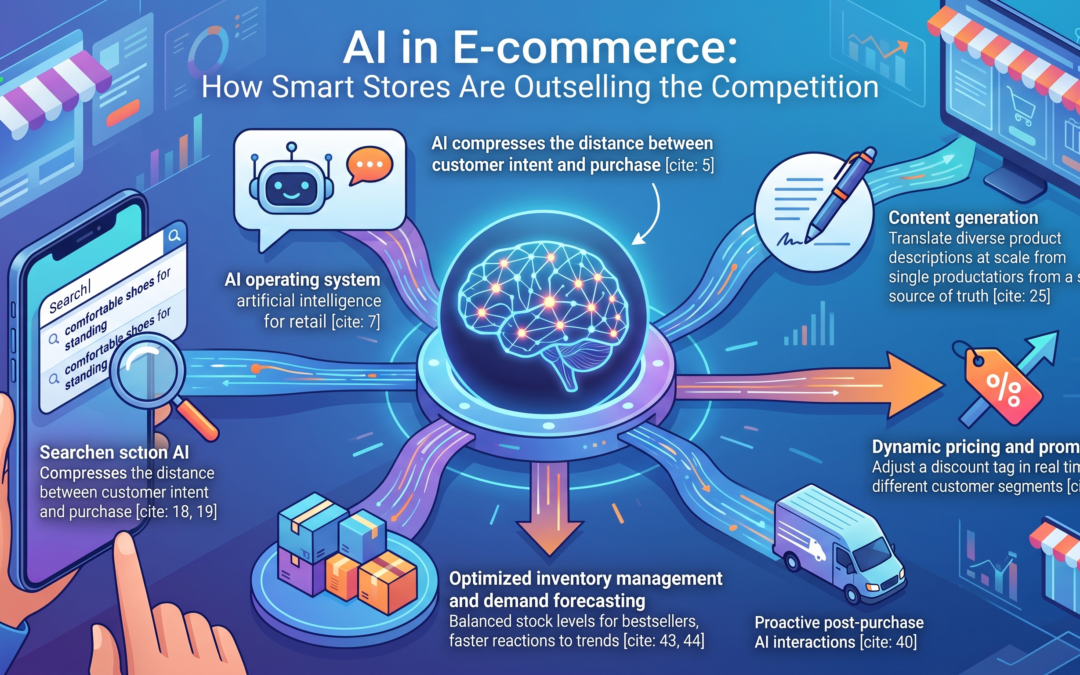
AI in E-commerce: How Smart Stores Are Outselling the Competition
From product discovery to fulfillment, AI is now the operating system of online retail.
E-commerce growth has slowed. Acquisition costs have not. The brands still winning in 2026 are not necessarily the ones with the best products or the largest ad budgets. They are the ones using AI to compress the distance between a customer’s intent and a completed purchase, then doing the same thing again on every visit afterwards.
AI in e-commerce stopped being a future-tense conversation about two years ago. Today it shows up in the smallest details of the buying experience: the search bar that understands a typo and a synonym, the product photo that reflects the customer’s skin tone, the chat assistant that knows the customer’s order history. Below are the highest-impact places we are deploying AI for e-commerce clients right now, and what kind of return to expect from each.
Personalization that goes beyond the obvious
Most stores still personalize using a primitive playbook: “Customers who bought X also bought Y.” Modern AI personalization is far richer. It blends behavioral signals (what the visitor browsed in the last five minutes), contextual signals (device, time of day, weather, traffic source), and predictive signals (what cohort this visitor most resembles) to assemble a unique homepage, category sort order, and product page recommendations in real time.
Done well, this lifts conversion rates by 15 to 35 percent, with no change in traffic or pricing. Done poorly, it produces creepy or irrelevant suggestions that erode trust. The discipline is to personalize the experience, not just the product feed: tailor the messaging, the social proof, the urgency cues, and the navigation order to who the visitor actually is.
Search and discovery built for humans, not databases
On most stores, on-site search is still the most underutilized lever. Half of visitors who use the search bar leave if the first three results are wrong. AI-powered search — vector search, semantic understanding, image search, and conversational search — fixes this by understanding intent rather than matching strings.
A customer typing “comfortable shoes for standing all day” should see ergonomic options, not a list of products with the word “day” in the title. A shopper uploading a photo from Instagram should be matched to the closest item in the catalog. An AI assistant in the corner of the screen should be able to answer “what’s the difference between these two jackets?” without making the customer compare specs themselves. These features are no longer luxury. They are the new baseline.
Generative content at catalog scale
Most growing brands have hundreds or thousands of SKUs and a content team of two. The math never works. AI now closes that gap. Generative models can produce product descriptions in five tones of voice, translate them into ten languages, and adapt the angle for SEO, paid social, and marketplaces — all from a single source of truth in your PIM.
The same technology produces lifestyle imagery, model variations, and short-form video at a fraction of the cost of a traditional shoot. The right way to use this is not to fire your creative team. It is to free them from repetitive work so they can focus on the campaigns and stories only humans can tell. Brands that resist generative content for purist reasons will lose to brands that use it well — quietly, on brand, with a human in the editing chair.
Pricing and promotion that adapt in real time
Static pricing is leaving money on the table. AI-driven dynamic pricing uses demand signals, competitor pricing, inventory levels, and customer cohort to adjust list prices and discount depth in real time. The version that works is not the version that hammers customers with constant change — it is the version that smooths inventory, protects margin on hot SKUs, and offers smart bundles when a customer is on the fence.
Promotions get the same treatment. Instead of running a single 20 percent off code for everyone, AI segments customers and offers the smallest incentive that converts each one. A loyal repeat buyer gets free shipping. A first-time visitor gets 10 percent off. An at-risk lapsed customer gets a personalized comeback offer. Margin per dollar of promotion improves, sometimes dramatically.
Conversational commerce and post-purchase AI
Chat is no longer a support channel. It is a sales channel. Modern AI assistants can recommend products, answer technical questions, check stock, schedule deliveries, and recover abandoned carts — across the website, WhatsApp, Instagram, and email. The best deployments hand off to a human at the moment a customer needs one, and document the conversation so the next interaction picks up where the last one left off.
Post-purchase is where the real loyalty is built. AI-driven order updates, proactive shipping alerts, smart returns, and personalized re-engagement campaigns turn a one-time buyer into a repeat customer at a fraction of the cost of acquiring a new one. Many brands still treat post-purchase as a logistics problem. The ones that treat it as a marketing channel grow much faster.
Inventory and demand forecasting
Out-of-stocks and overstocks each kill profitability in different ways. Machine-learning forecasting models that incorporate historical sales, seasonality, marketing calendars, weather, and external trends now outperform traditional planning by a wide margin. The result is fewer stockouts on bestsellers, less capital tied up in dead inventory, and faster reaction to viral demand.
This is one of the highest-leverage AI investments for any brand doing more than a few million in revenue. Inventory accuracy compounds: every percentage point of forecast accuracy translates into freed cash, more available products, and fewer markdowns. Most brands recover the cost of the project within a single buying cycle.
Fraud, returns, and operational AI
AI is also quietly transforming the parts of e-commerce customers never see. Fraud detection systems now block fake checkouts and bot attacks in real time, protecting both margin and inventory. Return-prediction models flag orders likely to be returned and intervene with size guidance or alternative recommendations before the order ships. Customer service routing models triage tickets and resolve a growing share of them without human involvement.
Each of these is a small efficiency on its own. Together they reshape the unit economics of e-commerce. Brands that compound these gains across the back office can afford to invest more in customer experience and acquisition than competitors who are still doing this work manually.
Where to start
Trying to do everything at once is the fastest way to get nothing done. Pick one bottleneck in your funnel — usually search, personalization, or post-purchase — and ship a focused AI deployment that you can measure within ninety days. Build trust internally with a clear win, then expand. The brands we work with that take this approach end the year with a stack of compounding improvements rather than a single failed transformation project.
The most important thing to remember is that AI is not a feature. It is a way of building. The teams that succeed treat it as a capability layered into every decision — pricing, design, content, support, fulfillment — rather than a single tool bolted onto a static site. That mindset, more than any specific technology, is what separates the brands pulling ahead from the ones falling behind.
Ready to put this into practice? MEWS designs, builds, and optimizes high-performing digital experiences — from custom websites to AI-driven e-commerce. Talk to our team about your next project.
 MEWS is a full service web development Internet marketing company and technology integrator founded in 2003, by leading industry consultants with previous technology experience.MEWS is an Internet services and solutions company with interests in website development – Mobile applications– domain name registrations - web hosting.